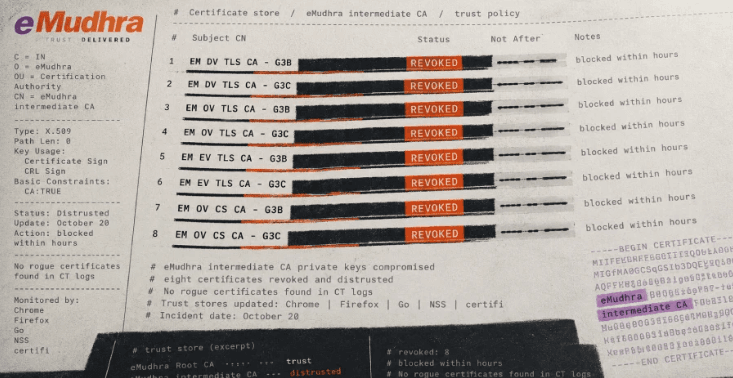
The Go programming language team released two emergency updates on October 20 — versions 1.27.3 and 1.26.10 — that block eight intermediate certificate authority keys from being trusted by Go's certificate verifier. Any program compiled against the updated releases will refuse to establish connections to sites or services whose certificates were issued under those keys.
Which CA Is Affected
According to aggregated reporting, the eight keys belong to eMudhra, a certificate authority. The Go team did not publicly name the CA in its own release notes, but broader coverage of the incident identifies eMudhra as the source of the compromised intermediate certificates.
Wider Industry Response
The Go patches are not an isolated action. According to Ars Technica, the discovery of the eight compromised TLS certificates put the internet on high alert. Firefox also shipped a targeted update — version 158.0.1 — specifically to block the same eMudhra intermediate certificates, as reported by 9to5Linux. The coordinated response across browsers and software toolchains suggests the issue was treated as significant by multiple parties in the web security ecosystem.
What the Update Does
Programs built with the new Go releases will reject certificate chains that pass through any of the eight flagged keys. This means connections to services relying on certificates issued under those keys will fail rather than proceed silently. Developers and operators using Go to build TLS-dependent software are expected to rebuild or update their binaries to pick up the new verification behavior.
What Remains Undisclosed
The Go team has not provided detailed public information about the precise nature of the security concern that prompted the block. The extent to which certificates issued under the affected keys are actively in use on the public internet has not been specified in the available sources.