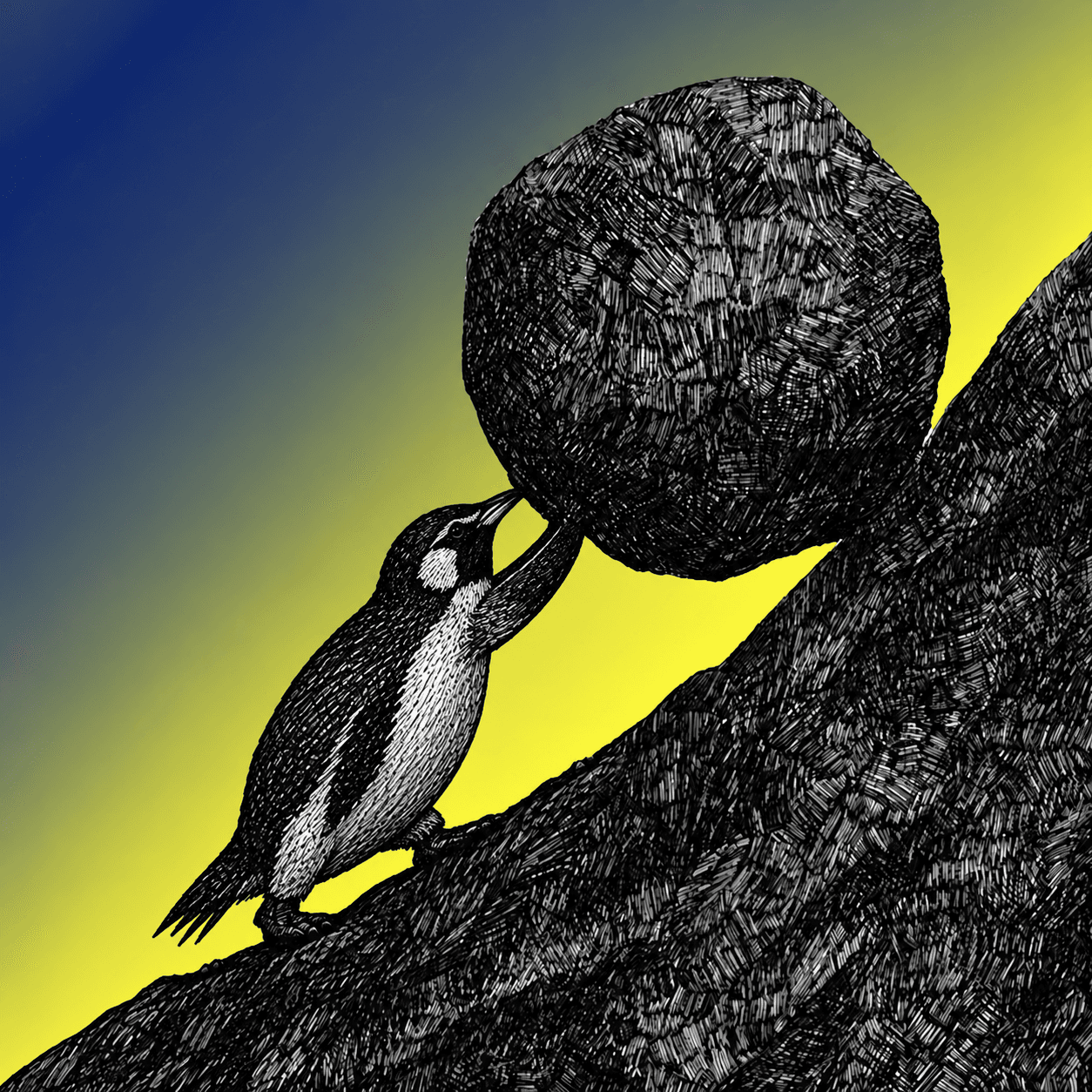
Werner Herzog's next film is reportedly titled "The Sisyphean Penguin" The project is said to follow a penguin through a haunting story about repetition, survival, memory, and the absurdity of existence. Classic Herzog.
German filmmaker, actor, opera director, author, and documentarian. Regarded as a pioneer of New German Cinema, his films often feature ambitious protagonists with impossible dreams, people with unusual talents in obscure fields, or individuals in conflict with nature. His film-making process involves avoiding storyboards, emphasizing improvisation, and placing his cast and crew into real situations mirroring those in the film on which they are working. He has received numerous accolades including a Silver Bear Award, four Awards at the Cannes Film Festival and the Golden Lion for Lifetime Achievement at the Venice Film Festival in addition to a nomination for an Academy Award.
Herzog, along with Rainer Werner Fassbinder, Wim Wenders, and Volker Schlöndorff, led the beginning of the New German Cinema, which included documentarians who filmed on low budgets and were influenced by the French New Wave. He developed a habit of casting professional actors alongside people from the locality in which he was shooting. His films, "usually set in distinct and unfamiliar landscapes, are imbued with mysticism." Herzog says his youthful experience with Catholicism is evident in "something of a religious echo in my work".
In the winter of 1974, German-French writer Lotte H. Eisner, a friend and mentor of Herzog's since the late 1950s, fell gravely ill. Herzog walked from Munich to Paris, believing that she would not die if he did so. During these travels, which took him three weeks, he kept a diary that was eventually published as Of Walking in Ice. Eight years later, the 87-year-old Eisner allegedly complained to Herzog of her infirmities and told him, "I am saturated with life. There is still this spell upon me that I must not die—can you lift it?". He says that he agreed to do so, and she died eight days later.
Herzog's films have received considerable critical acclaim and achieved popularity on the arthouse circuit. They have also been the subject of controversy in regard to their themes and messages, especially the circumstances surrounding their creation. A notable example is Fitzcarraldo, in which the obsessiveness of the central character was reflected by the director during the making of the film. Burden of Dreams, a documentary filmed during the making of Fitzcarraldo, explored Herzog's efforts to make the film in harsh conditions. Herzog's diaries during the making of Fitzcarraldo were published as Conquest of the Useless: Reflections from the Making of Fitzcarraldo. Mark Harris of The New York Times wrote in his review: "The movie and its making are both fables of daft aspiration, investigations of the blurry border between having a dream and losing one's mind."